INTERSTELLAR MEDIUM
What does the almost empty space between stars have to do with planetary science?
Quite a lot, although the connection begins long before planets exist. Stars and planetary systems form when regions of interstellar gas and dust become sufficiently cold and dense to collapse. Part of this material eventually forms a disc around a young star, and within that disc planets, moons, asteroids and comets may emerge. The interstellar medium is therefore the raw material from which planetary systems are ultimately assembled.
This interstellar material is extremely dilute, but it is neither uniform nor motionless. Warm diffuse gas resides in the volume surrounding colder and denser clouds, while the entire mixture is stirred by turbulence. Turbulence simply means that the gas moves chaotically, producing irregular currents, eddies, shocks and compressions instead of flowing smoothly. Several processes help sustain these motions. In particular, massive stars release powerful winds and eventually explode as supernovae, sending blast waves through the surrounding gas and stirring the interstellar medium on enormous scales.
There is another phenomena, known as cosmic rays, which is intimately related to turbulence. Despite their name, cosmic rays are not rays of light. They were named before their true nature was understood, when they were thought to be a form of electromagnetic radiation. We now know that they are mostly extremely energetic protons, atomic nuclei and electrons that travel throughout the Galaxy. Galactic magnetic fields continually deflect them, causing their paths to bend and become scrambled rather than travel in straight lines like light. In turbulent gas, moving magnetic fields trap these particle and bounce them over and over again, in a way that passes a lot of energy into them before escaping into deep space as cosmic rays.
When a cosmic-ray particle collides with an atom or molecule, it can knock out one of its electrons. This process is called ionization. The initially neutral particle is left with a positive electric charge, while the displaced electron is released into the gas. This apparently simple event initiates subsequent chains of chemical reactions and can strongly affect the composition of an interstellar cloud. The cosmic-ray ionization rate measures how frequently such events occur.
We cannot place a particle detector inside a distant cloud, so astronomers infer the cosmic-ray ionization rate indirectly. When light from a bright background star or another luminous source passes through a cloud, the different molecules within the cloud absorb light at particular wavelengths. They leave recognizable fingerprints in the observed spectrum. Some useful fingerprints belong to the small molecules OH⁺, H₂O⁺ and H₃⁺. The superscript “+” means that each molecule carries a positive electric charge because it has one fewer electron than a neutral molecule. These charged molecules are created and destroyed relatively easily, so their abundance is sensitive to the cosmic rays and physical conditions within the gas. Observations show that their abundances vary greatly between different directions in the sky. This has commonly been interpreted as evidence that the cosmic-ray ionization rate also varies greatly from one region to another.
But there is a catch. This interpretation usually assumes chemical 'equilibrium': which in other words means it assumes that the chemistry within every parcel of gas has had sufficient time to adjust to its present density, temperature and radiation environment. However, the real interstellar medium is constantly moving. What happens if turbulence transports the gas from one environment to another faster than its chemistry can respond?
One of the principal actors in this story is molecular hydrogen, H₂, which consists of two hydrogen atoms bound together. Two hydrogen atoms form H₂ mainly after meeting on the surfaces of tiny interstellar dust grains. Molecular hydrogen forms more efficiently in dense gas and survives there because dust, together with the H₂ itself, blocks the ultraviolet radiation that can split the molecule apart. In exposed diffuse gas, much less H₂ is expected to survive as a result of such dissociation.
Imagine, however, taking an ice cube from a freezer and placing it in a warm room. From the temperature of the room alone, one might conclude that ice should not be present. Yet the ice does not disappear instantaneously. For a while, it retains a memory of where it came from. We find that interstellar gas behaves similarly. In our three-dimensional computer simulations, turbulent motion carries H₂-rich gas out of cold clouds and into their warmer, more diffuse surroundings faster than the molecular hydrogen can be destroyed. The H₂ therefore survives in thin skins surrounding the cold structures, while an alternative calculation based only on the present local conditions predicts that almost none should exist. The chemistry retains a memory of the gas parcel’s previous environment. This can be identified in the plot below. The Y axes show the fraction of molecular hydrogen abundance, and the mutual x axis shows the density of the gas. The top panel is the equilibrium benchmark, that is, showing what the molecular hydrogen distribution should be like under the assumption of equilibrium. The average trend line is the dashed black line going through the distribution. The bottom plot is the actual molecular hydrogen abundance coming from simulations which incorporate turbulent motion, as explained further below. It can be seen that at intermediate densities, a time-dependent molecular hydrogen abundance can wildly exceed the equilibrium benchmark by up to several orders of magnitude.

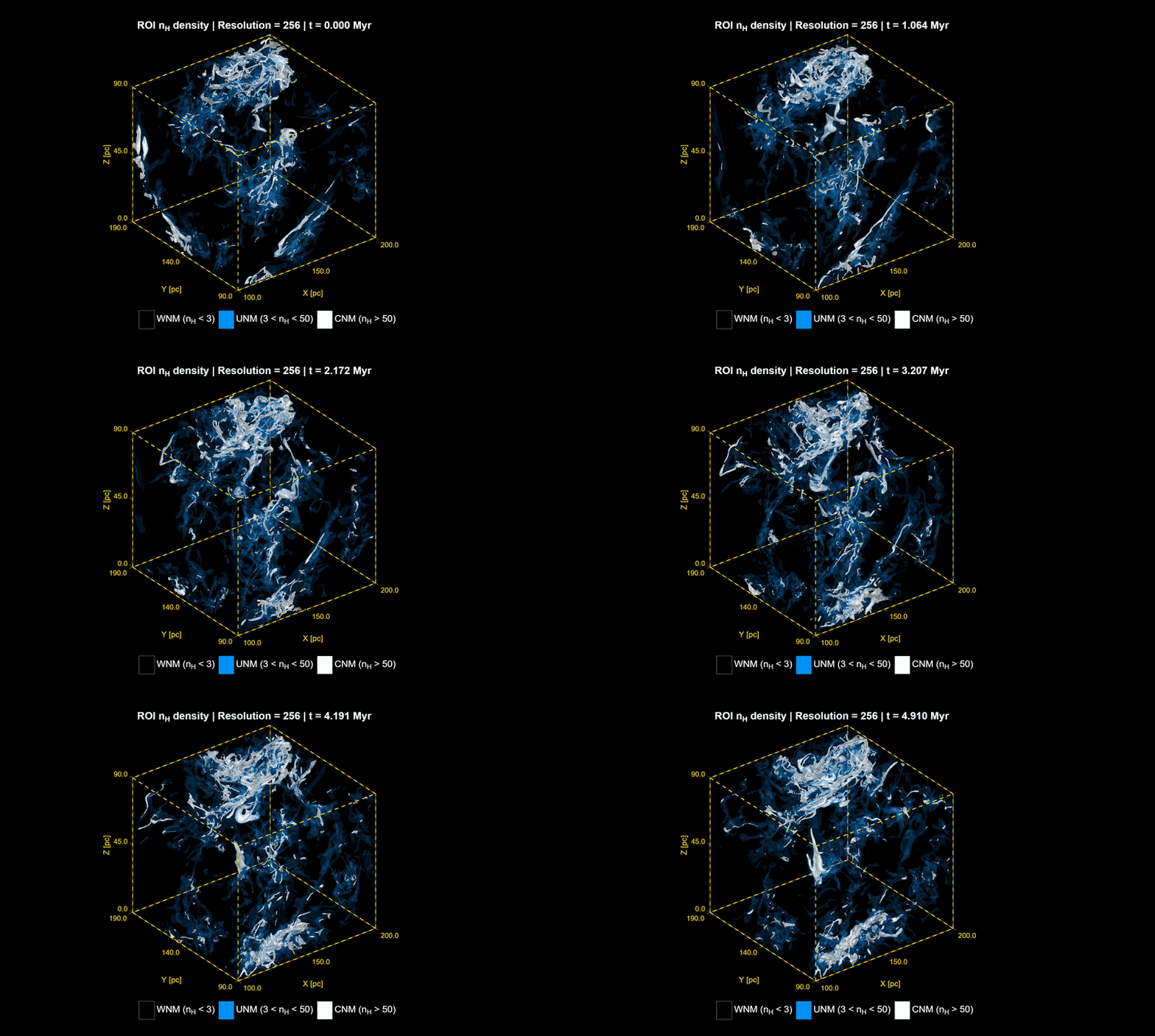
My collaborators and I used such simulations in order to theorize how the interstellar medium might look like, and what are its statistical properties. Such simulations take into account the bulk motion of gas, also affected by magnetic fields (known as magneto-hydrodynamic, or MHD simulations), in addition to the physics that affects the gas like heating and cooling, and, in addition, chemistry affecting hydrogen, either atomic or molecular.
Here's a nice movie sequence that zooms in on a specific patch in the simulations, and shows how the various phases (parts of the clouds that have different density and properties) in the gas, behave as a function of time (here tracked for 5 Myr at extremely high resolution).
My collaborators and I used such simulations in order to create mock observations. A real telescope cannot separately measure every parcel of gas between us and a background source. Instead, the resulting spectrum combines all the absorption produced along that narrow path through space. We mimicked this by drawing many imaginary paths through the simulated gas and summing the amount of hydrogen and each molecular ion encountered along every path. Repeating the procedure, we produced a synthetic collection of measurements that could be compared directly with the real observations.
Remarkably, while keeping the cosmic-ray ionization rate fixed throughout the simulation, we reproduced much of the observed variation in OH⁺, H₂O⁺ and H₃⁺. The effect is strongest for OH⁺ and H₂O⁺ because these molecules are abundant in the H₂-rich skins surrounding cold gas structures. H₃⁺ is found mostly in denser gas, where chemical equilibrium is a better approximation. This does not prove that the cosmic-ray ionization rate is identical everywhere. It does show that variations in molecular abundances are not, by themselves, unambiguous evidence for variations in cosmic rays. Some of the apparent variation is produced simply by observing different paths through a turbulent and highly structured interstellar medium.
In a follow-up study, we tested the same idea using the chlorine-bearing ions HCl⁺ and H₂Cl⁺, the latter commonly known as chloronium. Chloronium has presented a long-standing puzzle because substantially more of it is observed than traditional equilibrium models predict. Unlike OH⁺, H₂O⁺ and H₃⁺, the chlorine chemistry begins mainly with ultraviolet light rather than cosmic rays. We therefore cannot make the disagreement disappear by simply adjusting the cosmic-ray ionization rate. Accounting for the chemical memory of the gas brought the theoretical predictions considerably closer to the observations. HCl⁺ was essentially reproduced, while part, but not all, of the chloronium discrepancy was resolved. The remaining difference points toward the rate at which H₂Cl⁺ encounters an electron and breaks apart, a process known as dissociative recombination.
Our results predict that the destruction rate used for cold interstellar H₂Cl⁺ may need to be reduced by approximately a factor of four. A previous investigation that assumed chemical equilibrium required a considerably larger correction. By accounting for the out-of-equilibrium chemistry, we have therefore reduced the required change and provided a more specific target for future laboratory experiments.
Together, these studies suggest that interstellar chemistry is not merely a photograph of where the gas is today. It is also a travel diary, carrying information about where the gas has been and how it arrived there. That history is written into the material from which future stars and planetary systems may eventually form.